
Ageing of bitumen governs long-term pavement performance, influencing stiffness, cracking resistance, and durability. While conventional binder tests can capture the effects of ageing, they offer limited insight into the chemical processes driving these changes. Fourier Transform Infrared (FTIR) spectroscopy fills this gap by directly quantifying ageing at the molecular level.
As bitumen ages due to heat and oxygen exposure, new oxygen-containing functional groups form within the binder. FTIR enables precise monitoring of this process through characteristic absorption bands, most notably carbonyl (C=O) and sulphoxide (S=O) groups. The growth of these bands can be translated into ageing indices, providing a consistent and reproducible measure of oxidative ageing across different binders, ageing conditions, and durations.
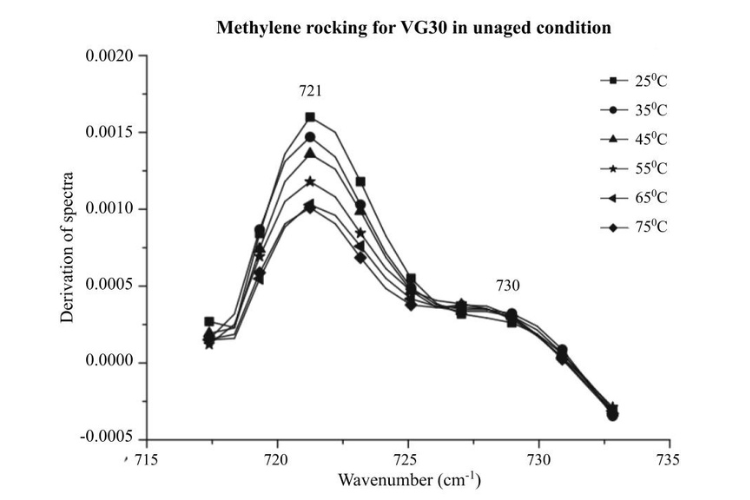
Beyond oxidation, FTIR also helps distinguish irreversible chemical ageing from reversible temperature-induced changes in the binder’s internal structure. By tracking hydrocarbon-related peaks, FTIR clarifies whether observed property changes arise from structural rearrangement or true chemical degradation, an important distinction when evaluating laboratory ageing protocols and field relevance.
When modifiers are introduced, FTIR analysis shows that a substantial portion of ageing can occur during the production process itself, owing to high temperatures and extended mixing times. In many cases, the interaction between binder and modifier stabilizes early, while oxidation continues to evolve during service. This makes chemical quantification of ageing especially critical.
Within the context of recycling and high-RAP pavements, FTIR becomes an invaluable tool. It enables direct assessment of the ageing state of reclaimed binders and supports rational decisions on blending, rejuvenation, and reuse. The MAXRAP project is precisely focused on addressing this challenge, using FTIR and complementary techniques to better understand, quantify, and manage ageing in recycled asphalt systems
References:
1. M.R. Nivitha, Edamana Prasad & J.M. Krishnan (2016) Ageing in modified bitumen using FTIR spectroscopy, International Journal of Pavement Engineering, 17:7, 565-577. https://www.tandfonline.com/doi/full/10.1080/10298436.2015.1007230
2. M.R. Nivitha, Edamana Prasad & J.M. Krishnan (2019) Transitions in unmodified and modified bitumen using FTIR spectroscopy. Materials and Structures, 52, 7 (2019). https://link.springer.com/article/10.1617/s11527-018-1308-7