
In hot recycling of aged bituminous materials, virgin binders and recycling agents are incorporated to restore compliance with target specification parameters. While these additives cannot reverse oxidation or fully restore the chemical composition of the aged binder to its unaged state, their effects are generally attributed to three mechanisms: (i) softening of the aged binder through an increase in lighter fractions, (ii) rebalancing the polarity of the binder fractions, and (iii) redistribution of molecular associations formed during oxidative aging. These mechanisms are largely hypothetical, and confirming their occurrence for a specific class of recycling agent requires characterization techniques capable of providing experimental insight into the underlying physicochemical interactions.
Complementary approaches, such as rheological testing, polarity-based fractionation techniques (TLC and SAR-AD), and functional group analysis (FTIR spectroscopy), can reveal changes in macroscopic response and shifts in the relative proportions of chemically defined fractions. Nevertheless, direct evidence of molecular associations and internal structural rearrangements remains limited.
Atomic Force Microscopy (AFM) offers a means of addressing this gap by enabling morphological imaging with nanoscale mechanical characterization through force-displacement measurements. Although the origin of the observed microstructural features remains a subject of debate, qualitative interpretation of AFM images has consistently proven useful for the comparative assessment of binders subjected to different aging conditions. Assuming these morphological features reflect the underlying binder microstructure, AFM topography reveals increasing spatial associations as aging progresses. The addition of a tall oil-based RA promotes a more dispersed microstructure, though this dispersion effect plateaus beyond a certain dosage. Concurrently, the skewness of the Derjaguin-Muller-Toporov (DMT) modulus distributions indicates an increase in the relative proportion of low-modulus regions, consistent with rheological softening.
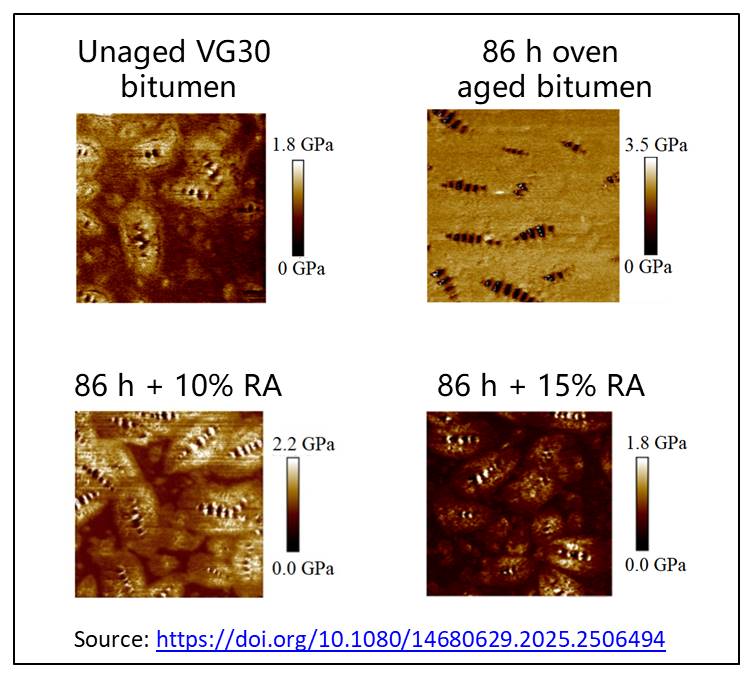
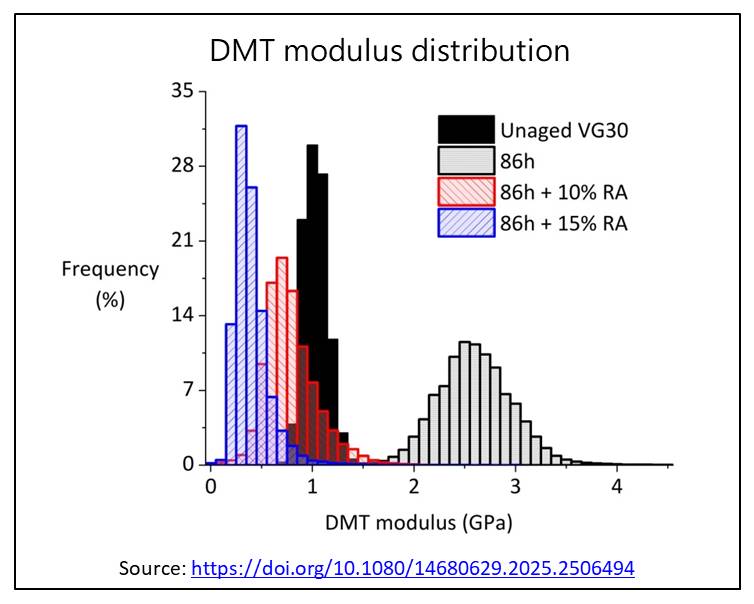
Taken together, these observations demonstrate that AFM provides insight into both microstructural dispersion and binder softening. More importantly, it can help identify dosage thresholds beyond which additional RA primarily increases softening by further increasing lighter fractions, rather than promoting additional redistribution of molecular associations. Identifying these thresholds is valuable for practical recycling, as it provides a mechanistic basis for defining optimal dosage limits for different aged binders and recycling agent types.
References:
1. Abinaya, L., Lakshmi Roja, K., Yiming, W., Nivitha, M. R., Masad, E., & Murali Krishnan, J. (2026). Influence of recycling agent on binders of varying ages and effects on subsequent aging. Road Materials and Pavement Design, 27(4), 1120-1149.
https://doi.org/10.1080/14680629.2025.2506494
2. Derjaguin, B. V., Muller, V. M., & Toporov, Y. P. (1975). Effect of contact deformations on the adhesion of particles. Journal of Colloid and Interface Science, 53(2), 314–326. https://doi.org/10.1016/0021-9797(75)90018-1
3. Loeber, L., Sutton, O., Morel, J. V. J. M., Valleton, J. M., & Muller, G. (1996). New direct observations of asphalts and asphalt binders by scanning electron microscopy and atomic force microscopy. Journal of Microscopy, 182(1), 32-39. https://doi.org/10.1046/j.1365-