
RAP, or Reclaimed Asphalt Pavement, consists of aggregate particles bound together by aged asphalt mortar. The agglomeration of these particles traps a portion of the binder within the RAP agglomerate, making it significantly more difficult to reclaim when compared to binder present on non-agglomerated RAP particles. In addition, agglomeration alters the aggregate gradation from that originally used during pavement construction. Therefore, breaking down agglomerated RAP into individual aggregate particles becomes essential for reducing variability in recycled asphalt mixtures and maximizing utilisation of the available RAP binder.
The de-agglomeration of RAP particles can be achieved through multiple techniques, broadly classified into mechanical-action-based and solvent-based methods. For large-scale applications, mechanical-action techniques such as centrifuge crushing are feasible. In this technique, centrifugal action propels RAP particles against either a metallic surface or a material bed, and the resulting impact force is used to separate the asphalt mortar from the aggregate particles. The primary challenge in this process lies in maximizing mortar removal while simultaneously minimizing aggregate crushing to the greatest extent possible.
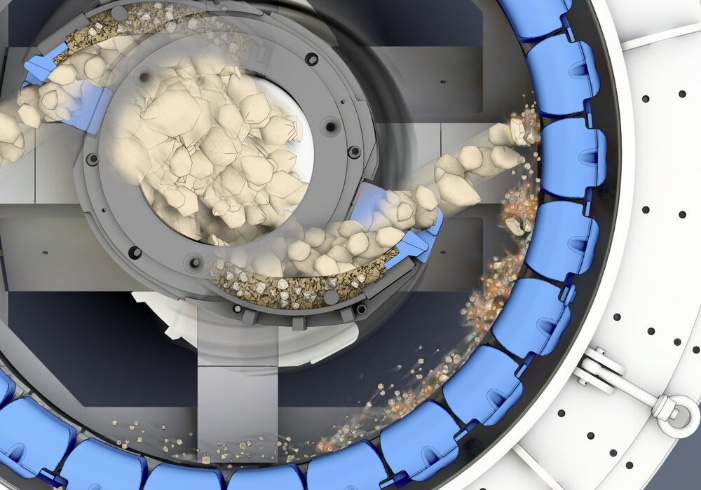
Two important experimental variables govern the efficiency of this process: the rotational speed of the crusher and the material lining used within the crushing chamber. The rotational speed controls the magnitude of the impact force, whereas the lining material influences the manner in which this force is transferred to the RAP particles. Understanding the individual and combined influence of these parameters on mortar removal and aggregate degradation is therefore critical. By systematically varying these variables, optimum processing conditions can be identified that achieve maximum mortar removal with minimal aggregate crushing. This is one of the main objectives of the MAXRAP project.
To advance this objective, the MAXRAP team visited the BHS-Sonthofen crushing facility on 3rd April 2025 to study the operational principles and capabilities of the equipment. Following this visit, preliminary experimental trials were conducted on 5th June 2025 to evaluate the influence of the selected experimental variables. Encouraging results obtained from these trials motivated further investigation, and a second phase of testing is scheduled for 21st May 2026. This research exercise is expected to significantly enhance RAP utilisation by improving the recovery of aged binder, reducing variability within recycled asphalt mixtures, and enabling better control over mix performance characteristics. Continue visiting the MAXRAP website for more interesting updates and developments in this area.